

Best Espresso Grinders (2026): Electric Grinders for Real Shots
By Juan Carlos Sosa (@thecoffeejuan) | Boquete Coffee Traders
An espresso grinder is not a coffee grinder that happens to go finer. Espresso forgives nothing: you are forcing water through a compressed puck in twenty-five seconds, and a shift in particle size too small to see changes the whole shot. That is why the grinder matters more than the espresso machine, and why a good machine paired with a filter grinder will never make a shot you are proud of.
IN A HURRY? OUR TOP PICKS
- Best overall: Eureka Mignon Specialita — stepless micrometric adjustment, 0.3 g retention, and the quietest grinder in its class.
- Best flat-burr flavor: DF64 Gen 2 — 64 mm flats, single-dose workflow, and a burr upgrade path most grinders never offer.
- Best workflow: Baratza Sette 270 — grind straight to a target weight, faster than anything else here.
- Best budget single-dose: DF54 Single Dose Grinder — 54 mm flats and stepless adjustment at roughly half the price of the DF64.
- Best cheap hopper grinder: Breville Smart Grinder Pro — doses straight into the portafilter, no fuss.
Best espresso grinders at a glance
| Grinder | Burrs | Adjustment | Retention | Best for | Price |
|---|---|---|---|---|---|
| Eureka Mignon Specialita | 55 mm flat steel | Stepless micrometric | ~0.3 g | Best overall, quiet kitchens | $$$ |
| DF64 Gen 2 | 64 mm flat steel | Stepless | ~0.2 g with bellows | Flavor ceiling, upgraders | $$$ |
| Baratza Sette 270 | 40 mm conical steel | 270 stepped settings | ~0.4 g | Speed and grind-by-weight | $$$ |
| DF54 Single Dose Grinder | 54 mm flat steel | Stepless | Very low, single dose | Budget single dosing | $$ |
| Breville Smart Grinder Pro | Conical steel | 60 stepped settings | Higher, hopper-fed | Cheapest sensible start | $ |
Price guide: $ under ~$200 · $$ ~$200–350 · $$$ ~$350+. Prices and stock move constantly in this category, so check before you commit.
ON THIS PAGE
Why an espresso grinder is a different machine
Two things separate an espresso grinder from a grinder built for filter.
Resolution at the fine end. Between a shot that runs in 20 seconds and one that runs in 35, the grind has moved by an amount you cannot see. A filter grinder's settings are spaced too far apart to land between them — you go one click and overshoot. An espresso grinder either has no clicks at all, or has so many that each one is a nudge rather than a jump.
It has to give the coffee back. Filter grinders can hold a gram or two of old grounds inside without anyone noticing. In espresso, where a dose is 18 grams and you change the setting constantly while dialing in, that trapped coffee wrecks you: you adjust, grind, and get a mix of the new setting and yesterday's. Low retention is not a luxury feature here. It is the difference between dialing in on three shots and dialing in on eight.
Everything else — burr size, motor speed, how quiet it is — is comfort. Those two are the reason a dedicated grinder exists.
Two quick signposts before we go on. If you brew filter as well and want one grinder for both, that is a different shortlist — see my guide to grinders for pour over and mixed brewing. And if you would rather grind by hand, the good hand grinders now pull espresso genuinely well: I cover grinding espresso by hand separately. And if the cup you are chasing is Turkish rather than a shot, that is finer still — powder, not espresso-fine — and it has its own shortlist in the best Turkish coffee grinders. Everything below is electric and espresso-first.
What actually matters in an espresso grinder
Stepless versus stepped
A stepless grinder has a collar you rotate continuously — infinite positions, no detents. You can make an adjustment finer than any click would allow, which is exactly what espresso wants. The trade is that returning to a setting takes a reference mark and some memory. A stepped grinder clicks into fixed positions, which is repeatable and beginner-friendly, but only useful for espresso if the steps are numerous enough to be small. Sixty steps across the whole range is coarse. Two hundred and seventy is workable.
Retention, and what to do about it
Retention is how much ground coffee stays inside the grinder. Under half a gram is good. A single-dose grinder with a bellows — you puff air through the chamber and push the last grounds out — gets close to zero. Grinders with big hoppers hold more, both in the chute and in the hopper throat.
Single dosing versus a hopper
Single dosing means you weigh exactly the beans for one shot and drop them in. It keeps your beans in a sealed bag instead of going stale in a clear plastic hopper under kitchen light, and it lets you switch coffees between shots without purging. It is slower per shot — unless you weigh a week of doses ahead into sealed tubes, which is exactly what the best single-dose coffee containers are for. A hopper is faster and more convenient if you drink the same coffee every day and get through it quickly.
Flat burrs or conical, for espresso specifically
For espresso the distinction is less about better and worse and more about the shape of the cup. Flat burrs tend to produce a narrower particle distribution, which in a shot reads as clarity and separation — you taste the individual notes. Conical burrs tend to give a slightly broader distribution, which reads as body and sweetness, a rounder shot. Neither is wrong. With a fruit-forward natural like the Elida Estate Catuai Natural I want flats, because the whole point is those berry and cherry top notes. With a chocolatey washed coffee I am perfectly happy on a conical.
Portafilter fit and dosing workflow
Check the basket diameter on your machine before you buy. Most entry and mid machines are 54 mm; most prosumer machines are 58 mm. Some grinders ship with a dosing cup or fork sized for one and not the other. It is a five-dollar accessory rather than a dealbreaker, but it is annoying to discover on day one. If yours is a Breville Barista Express, which takes 54 mm, the best Breville Barista Express accessories cover the tamper, dosing funnel and basket upgrades that actually fit it.
The five best espresso grinders

1. Eureka Mignon Specialita
The one I recommend to most people without hesitating. The stepless micrometric collar gives you genuinely fine control, retention sits around 0.3 g so what comes out is what you just set, and it is remarkably quiet for a grinder in this class — which matters more than spec sheets admit when you are pulling a shot at six in the morning. Italian-built, sensible to live with, and nothing about it feels like a compromise until you get into hobbyist territory.
Burrs: 55 mm flat steel | Adjustment: stepless micrometric | Retention: ~0.3 g | Best for: anyone who wants to buy once
Check price on Amazon →
2. DF64 Gen 2
64 mm flat burrs at a price that used to buy 55 mm, in a single-dose body with a bellows that gets retention to roughly 0.2 g. In the cup it is the most transparent grinder here — light roasts and single origins separate out in a way the conicals do not manage. It is also the only pick with a real upgrade path: swap in third-party burrs later and you have a meaningfully different grinder. Two honest caveats: the grounds come out clumpy, so you will want a WDT tool to break them up before tamping, and the fit and finish is functional rather than lovely.
Burrs: 64 mm flat steel, upgradeable | Adjustment: stepless | Retention: ~0.2 g with bellows | Best for: light roasts, tinkerers
Check price on Amazon →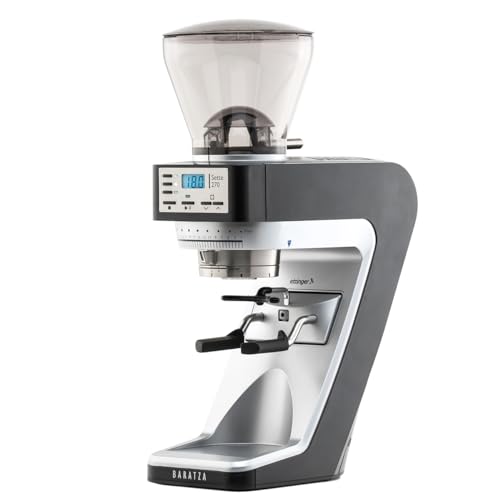
3. Baratza Sette 270
The Sette does something none of the others do: it grinds downward in a nearly straight line, so it is fast and it barely holds anything back. The 270 gives you 270 stepped positions, which is enough resolution to dial espresso properly, and the Wi version adds a built-in scale so you grind to a target weight rather than a time. If your morning involves other people waiting, that speed is worth real money. The catch is noise — it is the loudest grinder here by a wide margin, closer to 80 dB, and you will know about it in a small apartment. Baratza's parts and service record remains the best in the business.
Burrs: 40 mm conical steel | Adjustment: 270 stepped | Retention: ~0.4 g | Best for: speed, grind-by-weight, serviceability
Check price on Amazon →
4. DF54 Single Dose Grinder
The DF64's smaller sibling — sold under the DF64Coffee, Turin and MiiCoffee names depending on the seller, all the same machine — and the most interesting thing to happen at the bottom of this market in years. You get 54 mm flat burrs and true stepless adjustment, the two features that actually define an espresso grinder, at roughly half what the DF64 costs. It grinds slower and the flavor ceiling is a step below its bigger brother, but nothing else at this price gives you stepless flats and a single-dose workflow. If your budget stops well short of the Eureka, buy this rather than stretching to a stepped hopper grinder.
Burrs: 54 mm flat steel | Adjustment: stepless | Retention: very low, single dose | Best for: the best espresso grind per dollar
Check price on Amazon →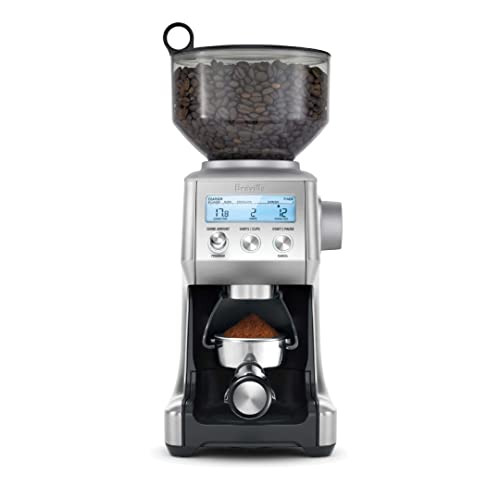
5. Breville Smart Grinder Pro
The pragmatic choice, and the one to buy if you are pairing it with a budget espresso machine and do not want to spend more on the grinder than the machine. Sixty settings, a hopper, a timer that remembers, and a cradle that doses straight into the portafilter so you are not transferring grounds between vessels. Be clear about its limits: sixty steps across the full range means the espresso zone is only a handful of clicks wide, so you will sometimes want a setting that sits between two of them, and it holds more coffee inside than anything else here. It will make you a good shot. It will not make you a great one.
Burrs: conical steel | Adjustment: 60 stepped | Retention: higher, hopper-fed | Best for: starting out on a tight budget
Check price on Amazon →Which espresso grinder should you choose?
| If this is you... | Buy | Because |
|---|---|---|
| You want to buy once and stop thinking about it | Eureka Mignon Specialita | Nothing about it will annoy you in two years |
| You drink light roasts and single origins | DF64 Gen 2 | 64 mm flats give the most separation in the cup |
| You make several shots back to back, for other people | Baratza Sette 270 | Fastest here, and grinds to a weight rather than a guess |
| You care about the shot but the budget is real | DF54 Single Dose Grinder | Stepless flats and single dosing, for half the money |
| You just bought your first espresso machine | Breville Smart Grinder Pro | Cheapest honest entry; upgrade the grinder later |
| You have a super-automatic machine | None of these | It grinds internally — choose the beans instead |
One rule I would hold to if you are building a setup from scratch: if you have to choose, put the money in the grinder. A modest machine with an excellent grinder beats an excellent machine with a modest grinder, every time. My guide to home espresso machines is where to spend what is left, and if you are ready for the prosumer tier, the best dual boiler espresso machines are exactly what a grinder like the Specialita or the DF64 was made to feed. The rule applies double on a hand-powered lever: the best manual espresso machines have no pump to muscle through an uneven grind, so the grinder does all the work.
How to dial in a shot on a new grinder
The first hour with a new grinder is where most people conclude they bought the wrong one. They did not; they just have not found the setting yet. Work through it in this order.
- Fix your dose and your target first. Weigh 18 g in, aim for 36 g out in 25 to 30 seconds. Do not change these while you hunt for the grind. You need one variable moving, not three. A scale that reads to 0.1 g is not optional for this.
- Start coarser than you think and walk down. Coming from too coarse gives you a fast, sour shot that clearly tells you which way to go. Coming from too fine gives you a choked machine and no information.
- Move in genuinely small amounts. On a stepless collar that is a few degrees of rotation, not a quarter turn. On the Sette, five or ten positions. On the Breville, one click, and accept that one click is a big move.
- Purge after every change. Run a few grams through and discard them, or your next shot is a blend of two settings. On a low-retention single-doser this barely matters; on a hopper grinder it matters a lot.
- Taste, do not just time. Sour and thin means grind finer. Bitter and dry means grind coarser. The clock is a guide; your mouth is the instrument.
- Expect to re-dial with each new bag, and after roughly a week as the coffee degasses. This is normal and it is not the grinder's fault.
If grind size in general is the part you find slippery, my coffee grind size chart maps every brew method, and Panama coffee for espresso covers which of our coffees suit a shot and how I pull them. And when your palate wants a second opinion, the best coffee refractometers put a hard extraction number on every shot you dial in.
Two popular grinders I left out, and why
The Niche Zero. An excellent grinder and deservedly loved — a genuine single-doser with near-zero retention. I have left it off because it is sold direct from the manufacturer rather than through normal retail, so for most readers here it is not a straightforward purchase, and availability in the United States has been inconsistent. If you are willing to buy direct and wait, it belongs on your shortlist.
The Fellow Opus. Beautiful object, well marketed as espresso-capable, and I keep seeing it recommended. Experienced users report real difficulty getting consistent shots out of it, and I would not spend your money on a grinder whose espresso performance is that contested when the DF54 exists at a similar price. For filter it is a different conversation.
The grinder is only half of it
Our Elida Estate Catuai Natural from the Lamastus Family — ripe berries, cherry and apricot, grown on Panama's highest coffee farm — is sourced fresh directly from the producer and delivered worldwide in 5 days.
Shop Elida Catuai Natural →To finish the setup: espresso accessories and a tamper kit cover the WDT tool and distributor you will want alongside a flat-burr grinder, coffee scales handle the dose and yield, espresso cups and glassware are the last mile, and cleaners and descalers keep it all honest. And if limescale has already caught up with your machine, our step-by-step guide on how to descale an espresso machine walks through clearing it. Water matters more than most people expect too — see the best water for coffee. And if you are still choosing beans, whole bean versus ground explains why a grinder is the upgrade that changes everything. One thing no espresso grinder can claim, incidentally: SCA equipment certification covers filter brewers only — the certified lists for home grinders and home espresso machines are both empty — so the badge only means something on the drip side, where I went through the SCA-certified coffee makers one by one.
Espresso grinder FAQ
What is the cheapest grinder that can actually pull espresso?
Around the price of the Breville Smart Grinder Pro is where an electric grinder becomes genuinely usable for espresso, and around the price of the DF54 is where it becomes good. Below that, grinders lack the resolution at the fine end to land on a workable setting, and you will spend the money you saved on wasted coffee.
Are flat burrs or conical burrs better for espresso?
Neither is universally better. Flat burrs tend to give a narrower particle distribution, which in a shot reads as clarity and separation of individual flavors. Conical burrs tend to give a slightly broader distribution, which reads as body and sweetness. Flats suit light roasts and delicate single origins; conicals suit darker, chocolatey coffees.
What is single dosing and do I need it?
Single dosing means weighing the beans for one shot and putting only those into the grinder, rather than filling a hopper. You do not need it, but it keeps beans fresher in a sealed bag, lets you switch coffees between shots without purging, and usually comes with lower retention. The trade is a slower routine.
Why does grind retention matter so much for espresso?
Because you change the grind setting often while dialing in. Coffee trapped inside the grinder from the previous setting mixes into the next dose, so the shot you taste is not the setting you chose. Under half a gram of retention is good; a single-dose grinder with a bellows gets close to zero.
Do I need a stepless grinder for espresso?
Not strictly, but you need fine resolution one way or the other. Stepless adjustment gives infinite positions and the finest possible control. A stepped grinder works if it has enough steps that each one is a small move: 270 positions is plenty, 60 across the whole range is coarse.
Does a 54 mm or 58 mm portafilter change which grinder I should buy?
It does not change the grinder itself, but it changes the accessories. Some grinders include a dosing cup or fork sized for one diameter and not the other. Check your machine's basket size before ordering, and budget for a matching dosing cup or funnel if needed.
How long should it take to dial in a new espresso grinder?
Plan on a bag of coffee. Fix your dose and yield, start coarser than you expect, move in small increments, purge between changes, and taste rather than only timing. Expect to re-dial slightly with every new bag and again after about a week as the coffee degasses.
As an Amazon Associate, Boquete Coffee Traders earns from qualifying purchases.