

Best Turkish Coffee Grinders 2026: 5 Powder-Fine Picks
By Juan Carlos Sosa (@thecoffeejuan) | Boquete Coffee Traders
The best Turkish coffee grinder has to do one thing most grinders cannot: turn roasted beans into a powder as fine as flour. Turkish coffee is boiled unfiltered in a cezve, so every particle ends up in the cup, and a grind that is merely "espresso fine" gives you grit on the tongue and a thin, broken foam instead of the thick, velvety cup the method is famous for. Most burr grinders simply do not close down far enough. The five below do.
I have kept this list honest about what each one is. Three are traditional brass mills from Sozen, the Turkish family workshop that has been making them since 1890 — the size is the real decision there, so I chose three sizes rather than three near-identical brands. One is a modern precision hand grinder for the person who wants a single grinder for Turkish, espresso and pour-over. And one is an electric burr grinder for the household that brews Turkish coffee for guests and does not want to crank a mill for ten minutes.
IN A HURRY? OUR TOP PICKS
- Best overall: Sozen 7.6" Brass Manual Coffee Grinder — the authentic Turkish mill, handmade since 1890, at the size that grinds two cups without a fight.
- Best budget and travel: Sozen 6.4" Brass Manual Coffee Grinder — the same mechanism in a pocket-sized body.
- Best for a crowd: Sozen Hammered 9" Brass Manual Coffee Grinder — the big hopper and long crank for a full pot of four to six cups.
- Best hand grinder: 1Zpresso K-Ultra — 20-micron clicks and a 48 mm steel burr that goes to true powder, and still does pour-over on Sunday.
- Best electric: Breville Smart Grinder Pro — the rare electric burr grinder whose finest settings reach Turkish, with timed dosing.
Best Turkish coffee grinders at a glance
| Grinder | Type | Burr | Best for | Price |
|---|---|---|---|---|
| Sozen 7.6" Brass | Traditional brass mill | Conical steel, screw-adjusted | Authentic daily Turkish coffee | $$ |
| Sozen 6.4" Brass | Traditional brass mill | Conical steel, screw-adjusted | Budget, travel, one cup at a time | $ |
| Sozen Hammered 9" Brass | Traditional brass mill | Conical steel, screw-adjusted | Brewing for four to six | $$ |
| 1Zpresso K-Ultra | Precision hand grinder | 48 mm heptagonal steel, 20-micron clicks | One grinder for every method | $$$ |
| Breville Smart Grinder Pro | Electric burr grinder | Conical steel, 60 settings | Households, guests, no cranking | $$$ |
Price guide: $ under ~$60 · $$ ~$60–150 · $$$ ~$150+
ON THIS PAGE
What makes a good Turkish coffee grinder
Turkish coffee is the finest grind in coffee. Espresso is fine; Turkish is powder, somewhere below 100 microns, the texture of flour or cocoa. That single requirement rules out almost every grinder sold as "all-purpose," and it is why the traditional brass mill has survived for two centuries. Four things separate a grinder that can do it from one that only claims to:
- The burrs must close almost to touching. Flat-burr electrics and most cheap hand grinders bottom out at espresso. A Turkish grinder needs a conical steel burr that adjusts well below that — the brass mills use a screw under the crank that you tighten until the burrs nearly kiss.
- Steel burrs, not ceramic. Ceramic burrs chip and stall when forced this fine. Hardened steel takes the strain and keeps its edge.
- A slow, patient mechanism. Grinding to powder generates heat and takes time. The traditional mills are deliberately geared slow, which protects the aroma; the modern hand grinder gets there with sharper burrs and a big handle; the electric gets there by being the rare machine built with a genuinely fine bottom setting.
- A catch cup that holds the powder. Turkish grounds are so fine they behave like dust. A closed chamber that you unscrew is far tidier than an open cup.
One more honest note: none of these is fast. A traditional mill takes a couple of minutes per cup. That is part of the ritual, and it is the trade for a grind no blade grinder will ever match. If speed is the priority, the electric pick at the end of the list is the answer.
The 5 best Turkish coffee grinders

1. Sozen 7.6" Brass Manual Coffee Grinder
If you want the grinder the Turks themselves use, this is it. The Sozen family has been hand-making brass coffee mills in Turkey since 1890, and the mechanism has barely changed because it does not need to: a hardened conical steel burr driven by a folding crank, with a single screw underneath to set the grind. Tighten it fully and you get true Turkish powder; back it off and it will do a coarser grind for a French press, though powder is what it lives for. The 7.6-inch body is the sweet spot — a hopper big enough for two cups of Turkish coffee in one fill, and a crank long enough that the fine grind does not tire your wrist. Solid brass, no plastic, and it looks like an heirloom on the counter because that is what it is.
Height: 7.6 in | Burr: conical steel, screw-adjusted | Body: solid brass, folding crank | Best for: authentic daily Turkish coffee for one or two
Check price on Amazon →
2. Sozen 6.4" Brass Manual Coffee Grinder
Same workshop, same steel burr, same screw adjustment — just a smaller body. The 6.4-inch Sozen is the one to buy if you brew a single cup at a time, want to keep the outlay modest, or want a Turkish mill that goes in a bag. It fits in a coat pocket, weighs almost nothing, and needs no power, which makes it the grinder I would pack for a trip where a cezve and a camp stove are coming along. The only trade-off is capacity: one fill is one generous cup, and the shorter crank means slightly more turns per gram. For a first Turkish grinder, or a second one for the road, it is hard to beat.
Height: 6.4 in | Burr: conical steel, screw-adjusted | Body: solid brass, folding crank | Best for: one cup, tight budgets, travel
Check price on Amazon →
3. Sozen Hammered 9" Brass Manual Coffee Grinder
The big one. At nine inches the Sozen holds enough beans for a full cezve of four to six cups in a single fill, and the longer crank gives you the leverage that grinding that much powder demands. The hammered brass finish is the version I would choose for a kitchen where the mill lives on display — it hides fingerprints and wear, and it looks the part next to a copper coffee pot. Mechanically it is identical to its smaller siblings: hardened conical steel burr, screw adjustment, fully serviceable. It is heavier and takes more counter space, so this is the pick for the household that serves Turkish coffee to guests rather than the solo morning drinker.
Height: 9 in | Burr: conical steel, screw-adjusted | Body: hammered solid brass, folding crank | Best for: four to six cups per fill
Check price on Amazon →
4. 1Zpresso K-Ultra
This is the pick for the person who does not want a dedicated Turkish mill at all — who wants one serious hand grinder that does Turkish on Tuesday, espresso on Wednesday and a pour-over of Panama Geisha on Sunday. The K-Ultra can, because its 48 mm heptagonal steel burr adjusts in 20-micron clicks from an external dial, and the lowest settings reach a genuine flour-fine powder that most premium hand grinders stop short of. It is also fast: sharp burrs and a long folding crank mean a Turkish dose takes well under a minute rather than several. The magnetic catch cup snaps off cleanly and the whole grinder disassembles for cleaning without tools. It costs more than all three brass mills put together, and it looks like laboratory equipment rather than a bazaar heirloom — but as a single grinder for everything, it is the best on this list.
Burr: 48 mm heptagonal stainless steel | Adjustment: external dial, 20 microns per click | Capacity: 35–40 g | Best for: one grinder for Turkish, espresso and filter
Check price on Amazon →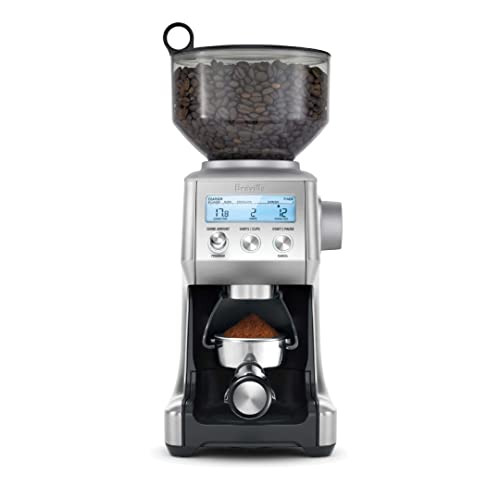
5. Breville Smart Grinder Pro
Most electric burr grinders cannot do Turkish coffee, full stop. The Smart Grinder Pro is the exception that makes it onto Turkish lists again and again, because its 60 settings run finer than the espresso range most machines stop at. Dialed to its lowest one or two settings it produces a powder that is not quite the commercial Turkish standard but is close enough for a proper cezve brew with a good foam — and it does it in seconds, with a timed dose you set once and repeat. That is the whole argument: if you brew Turkish coffee for a family or for guests, or your wrists are done with hand mills, this is the electric to buy. It is also a genuinely good grinder for drip and espresso, so it does not sit idle between Turkish sessions. The trade is that it is a plastic-and-steel countertop appliance, not a brass object of beauty.
Burr: conical stainless steel, 60 settings | Dosing: programmable timer, 0.2-second steps | Hopper: 18 oz | Best for: households and guests, no cranking
Check price on Amazon →Which Turkish coffee grinder should you choose?
If you want the real thing and brew for one or two: the Sozen 7.6". It is the size that balances capacity and effort, and it will outlive you.
If money or bag space is tight: the Sozen 6.4". Same grind, smaller body, lower price.
If you serve Turkish coffee to a table: the Sozen Hammered 9". One fill, one full pot.
If you want one grinder for every brew method: the 1Zpresso K-Ultra. It is the only pick here I would also recommend in our best manual coffee grinders guide.
If you refuse to crank: the Breville Smart Grinder Pro. Not quite bazaar-grade powder, but seconds instead of minutes.
How to grind for Turkish coffee
- Go finer than you think, then finer again. Rub a pinch between your fingers: if you can feel individual particles, it is not there yet. Turkish grounds should feel like flour or cocoa powder.
- On a brass mill, tighten the screw fully. The adjustment screw under the crank sets the burr gap. For Turkish coffee it goes all the way in, until the burrs almost touch. Loosen only if the crank binds.
- Grind slowly. Rushing a fine grind heats the coffee and stalls the burrs. A steady, unhurried crank gives a more even powder and keeps the aroma in the cup.
- Grind only what you brew. Powder-fine coffee stales within minutes because of its enormous surface area. One cezve, one grind.
- Use a medium roast. Very dark roasts turn ashy when boiled; very light roasts stay sharp. A medium-roast Arabica with body and sweetness is the classic choice, and it foams beautifully.
- Keep it dry. Never wash a brass mill or steel burr with water. A dry brush and the occasional handful of dry rice run through the burrs is all the cleaning they need.
A gram scale helps more here than in almost any other method, because a Turkish dose is small and the ratio is tight — see our guide to the best coffee scales. And if you want to see where Turkish sits against every other grind, our coffee grind size chart lays it out.
The right coffee for the cezve
Turkish coffee wants body and sweetness, not delicacy. Our traditional Café Palo Alto — deep caramel and cocoa from the hills of Boquete — is sourced directly from the producer in Panama and delivered worldwide in 5 days.
Shop Café Palo Alto →A grinder is half of the Turkish setup; the pot is the other half, and our guide to the best Turkish coffee pots covers the cezves and ibriks worth owning. If Turkish is only one of the ways you brew, the best manual coffee grinders and the best espresso grinders guides cover the wider field, and the best coffee grinders for pour-over is where to start if filter coffee is your daily cup. Once you are grinding fresh, keep the beans that way in one of the best coffee storage canisters, and for the brewing side of the story see our guide on how to brew Panama coffee.
Turkish coffee grinder FAQ
How fine should coffee be ground for Turkish coffee?
Finer than espresso: a true powder, roughly the texture of flour or cocoa. Because Turkish coffee is boiled unfiltered, every particle stays in the cup, so any grit shows up on the tongue. Most all-purpose grinders cannot grind this fine, which is why a dedicated Turkish mill or a hand grinder with a very fine range is worth buying.
Can a regular burr grinder make Turkish coffee?
Usually not. Most electric burr grinders and cheap hand grinders bottom out at an espresso grind, which is still too coarse. The Breville Smart Grinder Pro and the 1Zpresso K-Ultra are two of the few mainstream grinders whose finest settings reach Turkish powder. Traditional brass mills are built for it.
Can I use a blade grinder for Turkish coffee?
No. A blade grinder chops beans into a random mix of dust and chunks, and it heats the coffee as it runs. You will get grit, a thin foam and a muddy, uneven cup. A burr grinder that closes to a powder is the only way to get the texture right.
Are brass Turkish coffee grinders any good?
Yes, provided they are the real thing. Handmade Turkish mills from workshops like Sozen use hardened steel conical burrs and a screw adjustment that closes to true Turkish fineness. They are slow and hold only a cup or two per fill, but they grind more finely and more evenly than most modern grinders costing far more, and they last for generations.
How do I clean a Turkish coffee grinder?
Never with water. Brush the burrs and chamber dry after use, and every few weeks run a small handful of dry white rice through the mill to lift out oils, then brush again. Wipe the brass exterior with a dry or barely damp cloth. Water dulls the burrs and tarnishes the brass.
What coffee should I use for Turkish coffee?
A medium-roast Arabica with body and sweetness. Very dark roasts turn ashy when boiled and very light roasts stay sharp. Our Cafe Palo Alto from Boquete, with its caramel and cocoa depth, is the coffee we reach for in a cezve.
As an Amazon Associate, Boquete Coffee Traders earns from qualifying purchases.