

Best Manual Espresso Machines 2026: Real Lever Espresso at Home
By Juan Carlos Sosa (@thecoffeejuan) | Boquete Coffee Traders
A manual espresso machine is the most honest way to make espresso: no pump, no boiler full of electronics, just a lever, hot water, and your own two hands building the pressure. Get it right and the shot is as good as anything a machine costing ten times more can pull — and you made it, every bar of it. This guide covers the five lever espresso machines I would actually recommend, from a $99 starter to an Italian icon that has been in production for over 60 years, plus the cult levers you cannot buy on Amazon at all.
IN A HURRY? OUR TOP PICKS
- Best overall: Flair Classic — a pressure gauge, two portafilters, and genuine 9-bar espresso for a fair price.
- Best build under $250: Flair 49 PRO — a handled portafilter and zero plastic anywhere in the brew path.
- The icon (and best for milk drinks): La Pavoni EPC-8 Europiccola — a boiler, a steam wand, and 60+ years of Milanese history.
- Best premium: La Pavoni PC-16 Professional — the bigger brass boiler and a mounted pressure gauge.
- Best budget: Flair NEO Flex — real lever espresso, with a gauge, for about $99.
Best manual espresso machines at a glance
| Machine | Best for | Heat source | Milk | Price |
|---|---|---|---|---|
| Flair Classic | Best overall | Kettle water | No (add a frother) | $$ |
| Flair 49 PRO | Build quality, no plastics | Kettle water | No (add a frother) | $$ |
| La Pavoni EPC-8 Europiccola | The icon, milk drinks | Electric boiler | Yes, steam wand | $$$ |
| La Pavoni PC-16 Professional | Premium, back-to-back shots | Electric boiler | Yes, steam wand | $$$$ |
| Flair NEO Flex | Budget entry | Kettle water | No (add a frother) | $ |
Price guide: $ under ~$120 · $$ ~$120–300 · $$$ ~$300–1,000 · $$$$ ~$1,000+
ON THIS PAGE
What makes a good manual espresso machine
A lever espresso machine replaces the electric pump with you. You supply hot water, lower a lever, and the piston pushes that water through the coffee at espresso pressure. Because there is no pump, three things decide whether the shot in your cup is genuinely great:
- Pressure you can see. Real espresso happens between roughly 6 and 9 bar at the puck. A machine with a pressure gauge turns guessing into repeating: you watch the needle, hold the window, and pull the same shot tomorrow. Every pick on this list either has a gauge or a boiler that manages it for you.
- How it gets hot. The Flairs are unpowered: you preheat with water from a kettle, which keeps them simple, portable and cheap. The La Pavonis carry a real electric boiler, which means better temperature stability, back-to-back shots, and a steam wand for milk — at a real price.
- The brew path. Metal holds heat and lasts decades; plastic does neither. The step up from the budget picks to the premium ones is mostly a step up in what the water touches.
And the one thing nobody tells beginners: the grinder decides more than the machine does. A lever cannot rescue uneven grounds, and every machine here needs a true espresso-range grind. If you do not already own one, start with our guide to the best espresso grinders — or a capable hand grinder from the best manual coffee grinders.
The 5 best lever espresso machines
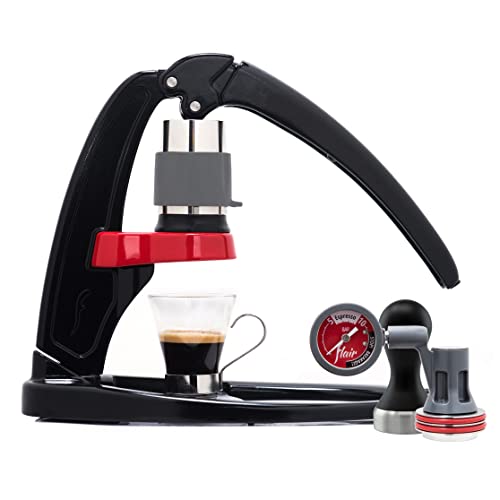
1. Flair Classic
The Flair Classic is where I point most people who want to try real lever espresso. It is a direct lever press with no electronics at all: you add about 60 ml of just-boiled water, dose up to 18 grams, and pull. The updated version ships with a pressure gauge and two portafilters — a forgiving Flow Control one for learning, and a bottomless 2-in-1 for when your grinder and technique are dialed in. The whole brewing head detaches for rinsing, which no other manual maker at this price does. The shot, done right, is dense, sweet and genuinely cafe-grade. What you give up is convenience: preheating with kettle water is part of the ritual, and there is no milk system.
Pressure: gauge included, 6–9 bar target | Dose: up to 18 g | Power: none, kettle preheat | Best for: the serious start in lever espresso
Check price on Amazon →
2. Flair 49 PRO
The 49 PRO is the Flair for people who plan to keep it forever. The headline is the brew path: nothing plastic ever touches your water or your coffee — it is stainless steel end to end. You also get a proper handled portafilter, which makes the workflow feel like a real machine rather than a gadget, and the same pressure gauge so you can hold the shot in the espresso zone. It pulls a bigger shot than the Classic and the extra mass helps it hold temperature through the extraction. Like every unpowered Flair, it wants a good grinder and a preheat routine — give it both and it rewards you with remarkable clarity, the kind that shows you what a washed Boquete coffee actually tastes like.
Brew path: zero plastic, stainless steel | Portafilter: handled, 49 mm | Power: none, kettle preheat | Best for: buy-once build quality
Check price on Amazon →
3. La Pavoni EPC-8 Europiccola
This is the lever espresso machine — a chrome Milanese design that has been in production, in essentially the same form, since the 1960s. Unlike the Flairs, the Europiccola has a real electric boiler: it heats its own water, holds temperature, and gives you a steam wand, which means true cappuccinos and lattes from a fully manual machine. Lifting the lever draws hot water over the coffee; lowering it drives the extraction. There is a learning curve — temperature management on a small boiler is a skill, and the group gets hot across a long session — but nothing else on this list makes espresso feel this much like a craft, or looks this good doing it. Buy it because you want the ritual and the icon, and plan to keep it for decades. Parts are still made for machines from the 1970s.
Boiler: electric, 0.8 L | Milk: steam wand included | Made in: Italy | Best for: the classic experience, milk drinks
Check price on Amazon →
4. La Pavoni PC-16 Professional
The Professional is the Europiccola grown up: a solid brass 38-ounce boiler (roughly double the capacity), a mounted pressure gauge so you can watch boiler pressure instead of guessing, and dual frothing systems for milk. The bigger boiler is the practical difference — more steam power, more shots before a refill, and steadier behavior when you are making drinks for guests rather than one quiet espresso for yourself. It is chrome-plated brass, made in Italy, and built the way things were built when repairing them was assumed. This is the most expensive machine on the list and the one that most rewards commitment; it is also the one people hand down.
Boiler: solid brass, 38 oz | Gauge: mounted pressure gauge | Milk: dual frothing systems | Best for: households, back-to-back drinks
Check price on Amazon →
5. Flair NEO Flex
Around $99 for real lever espresso, and it is not a toy. The updated NEO Flex now includes an integrated pressure gauge — unheard of at this price — and a thin-walled stainless brewing cylinder that skips the preheat step entirely: add boiled water and pull. The clever part is the two portafilters. The red Flow Control one builds pressure for you, so it works even with a modest grinder while you learn; the bottomless 2-in-1 is waiting for the day you upgrade your grind. The frame is a light polymer rather than metal, and that is the honest trade at this price. As a first lever, or a low-risk way to find out whether manual espresso is your thing, nothing touches it.
Pressure: integrated gauge | Portafilters: Flow Control + bottomless 2-in-1 | Preheat: none needed | Best for: first lever, tight budgets
Check price on Amazon →Which manual espresso machine should you choose?
If you drink espresso black and want the best value: the Flair Classic. The gauge and the two portafilters mean it grows with you instead of getting outgrown.
If you want the last unpowered lever you will ever buy: the Flair 49 PRO. All metal where it matters, nothing to wear out but gaskets.
If cappuccinos are part of the deal: the La Pavoni EPC-8 Europiccola. It is the only reasonable-money lever here with a boiler and a steam wand — and for milk drinks, pair it with a chocolatey Boquete coffee like our Café Palo Alto rather than a delicate Geisha.
If you are making drinks for more than one person: the La Pavoni PC-16 Professional. The double-size brass boiler is the difference between one lovely espresso and a round of them.
If you are curious but not committed: the Flair NEO Flex. If lever espresso hooks you — and it probably will — you lost nothing; if it does not, you spent less than a nice dinner finding out.
And if hand-pulled sounds romantic but you know yourself well enough to want a button at 6 a.m., a traditional pump machine from our guide to the best home espresso machines — or even one of the best budget espresso machines under $200 — will make you happier than a lever gathering dust. And if what you want is a lever's control over the shot with a boiler doing the heavy lifting, the prosumer machines in our guide to the best dual boiler espresso machines are the electric equivalent.
The cult levers you cannot buy on Amazon
Three names come up in every lever conversation, and none of them is sold on Amazon — which most roundups conveniently forget to mention. The Flair 58 is Flair's flagship: a commercial-standard 58 mm portafilter and an electric preheat system, sold through Flair directly and specialty retailers. The Cafelat Robot is a hand-built, completely plastic-free lever, made in small monthly batches and sold direct by Cafelat — if you find one in stock, that is the buy signal. And the 9Barista is a British-engineered stovetop lever, a genuine piece of thermodynamic jewelry, sold only from its maker. All three are superb. I left them off the ranked list not on merit but on honesty: you cannot click through and buy them here, and I would rather tell you that plainly than pretend otherwise.
A hand-pulled shot deserves a hand-picked coffee
Our Café Palo Alto — deep caramel and cocoa in the cup, with the body to carry a shot — is sourced directly from the producer in Panama and delivered worldwide in 5 days. On a lever, pulled straight or under milk, it is everything espresso should be.
Shop Café Palo Alto →How to pull a great lever shot
- Grind fine, and grind well. This is the whole game. Levers need a true espresso-range grind from a capable burr grinder; pre-ground coffee will gush.
- Preheat everything. On the unpowered Flairs, run hot water through the cylinder and over the portafilter before the real pull. Skipping this is the number one cause of sour, thin shots. (The NEO Flex is the exception — its thin cylinder needs none.)
- Watch the gauge, not the clock. Ease into 2–3 bar until the first drips appear, then hold 6–9 bar for the rest of the shot. The needle teaches you faster than any timer.
- Weigh in, weigh out. A 1:2 ratio — 18 grams in, about 36 grams out — is the starting point. A small scale makes every shot a data point; see our coffee scale guide.
- On a La Pavoni, mind the temperature. The small group heats up across a session. First shot after warm-up is the sweet spot; cool the group with a damp cloth between rounds.
- Clean while it is warm. Knock the puck, rinse the basket, wipe the piston. On the Pavonis, descale on schedule — our guide on how to descale an espresso machine covers it.
A lever is one piece of the setup. Round it out with the right espresso accessories, get the grind dialed with our coffee grind size chart, and if you want espresso pressure away from home, the collapsible levers and hand pumps in our best portable espresso makers guide travel where these cannot. The bottomless 2-in-1 portafilters that come with the Flairs are the same idea our guide to the best bottomless portafilters covers for 58 mm, 54 mm and 51 mm pump machines. Still mapping the whole territory? Start at the best coffee makers hub.
Manual espresso machine FAQ
Do manual espresso machines make real espresso?
Yes. A lever machine drives hot water through finely ground coffee at 6 to 9 bar, which is genuine espresso pressure, and produces a concentrated shot with crema. The difference from a pump machine is that you create and control the pressure yourself, which is exactly why enthusiasts love them.
Are manual espresso machines hard to use?
There is a learning curve, but it is shorter than people fear. Expect a week or two of practice to pull consistently good shots. A pressure gauge shortens the curve dramatically, and machines with a Flow Control style portafilter, like the Flair Classic and NEO Flex, are forgiving while you learn.
What grinder do I need for a lever espresso machine?
A burr grinder capable of a true espresso-range grind. This matters more than the machine itself: a lever cannot compensate for uneven grounds. A quality hand grinder works well and keeps the whole setup unpowered; a dedicated electric espresso grinder is the convenient choice.
Can you make lattes and cappuccinos with a manual espresso machine?
Only if it can steam milk. The La Pavoni Europiccola and Professional have boilers and steam wands, so they make true cappuccinos and lattes. The unpowered Flair machines brew espresso only; pair them with a standalone milk frother if you want milk drinks.
Is a Flair or a La Pavoni better?
They answer different questions. A Flair is simpler, cheaper, unpowered and easier to master, and it pulls a superb straight espresso. A La Pavoni costs more and demands more skill, but its boiler brings temperature stability, back-to-back shots and steamed milk, along with an heirloom build. Choose Flair for the shot, La Pavoni for the whole ritual.
What is the best coffee for a lever espresso machine?
Choose a coffee with sweetness, chocolate and body, like Cafe Palo Alto from Boquete: it pulls a rich, caramel-toned straight shot and cuts through milk beautifully on a La Pavoni. Save delicate floral coffees like Panama Geisha for pour-over, where their character actually comes through.
As an Amazon Associate, Boquete Coffee Traders earns from qualifying purchases.