

Best French Press Coffee Makers (2026 Guide)
By Juan Carlos Sosa | Boquete Coffee Traders
The best French press is still one of the most rewarding ways to brew — full-bodied, forgiving, and the purest way to taste what a coffee actually is, with nothing between the grounds and your cup but a steel mesh. After years brewing Panama's finest beans on every style of press, these are the seven I would actually put on a counter, judged by the only thing that matters: the cup.
IN A HURRY? OUR TOP PICKS
- Best overall: Bodum Chambord — the classic, does everything well at a fair price
- Best cup (cleanest): Espro P7 — double micro-filter means almost no grit
- Best insulated: Frieling Double-Walled Steel — keeps coffee hot for hours
- Best value: Secura 50 oz — premium performance at a budget price
- Best budget: Bodum Caffettiera — shatterproof and under $25
- Best for travel: Espro P1 Travel Press — brews and drinks on the go
ON THIS PAGE
Best French presses at a glance
| French press | Material | Capacity | Filter | Best for | Price |
|---|---|---|---|---|---|
| Bodum Chambord | Borosilicate glass + chrome steel | 34 oz (1 L) | 3-part steel mesh | The classic everyday cup | $$ |
| Espro P7 | Double-wall stainless steel | 32 oz | Double micro-filter | The cleanest, grit-free cup | $$$ |
| Frieling Double-Walled | 18/10 stainless, insulated | 36 oz | Two-stage mesh | Keeping coffee hot for hours | $$$$ |
| Secura | 304 stainless, insulated | 50 oz (1.5 L) | 3-layer mesh + 2 spares | Big batches and value | $ |
| Bodum Caffettiera | BPA-free plastic + steel filter | 34 oz | Reusable steel mesh | Budget and shatterproof | $ |
| Le Creuset Stoneware | Enameled stoneware | 34 oz (1 L) | Stainless plunger | Design and the dinner table | $$$$ |
| Espro P1 Travel Press | Double-wall stainless | 12 oz | Double micro-filter | Brewing on the go | $$ |
What makes a good French press
French presses all look alike, but a few design choices decide how good your coffee actually is. These are what I judge before recommending one.
Material and heat retention. Glass gives you the classic look and lets you watch the brew, but it loses heat fast — you will want to drink quickly or decant. Double-walled stainless steel and stoneware hold temperature far longer, which matters if you sip slowly or brew a big batch.
The filter. A standard single steel mesh gives that full, heavy, almost chewy body — but lets a little fine sediment through. A double micro-filter (as on the Espro models) virtually eliminates grit for a cleaner cup. Want it cleaner still? Drop a paper filter on top and you get a body closer to pour-over.
Grind quality. Here is the secret most guides skip: your grinder matters more than your press. A uniform coarse grind with few "fines" is what keeps grit out of the cup, no matter which filter you use. A blade grinder produces a mess of dust and boulders; a burr grinder fixes it. If your French press coffee is always muddy, the grinder is usually the culprit — see our guide to the best coffee grinders, or the best manual coffee grinders if you prefer to grind by hand.
Capacity and cleaning. Match the size to how many cups you actually pour, and favor presses that disassemble easily — the steel models are the simplest to clean and never break in the sink.
The 7 best French press coffee makers
1. Bodum Chambord

This is the French press most people picture, and for good reason. The borosilicate glass carafe in its polished chrome frame brews a rich, classic, full-bodied cup, the three-part steel filter is well designed, and it has been the standard for decades. Heat retention is modest because it is glass, so plan to drink it fresh or decant into a thermos — but for an honest everyday cup at a fair price, nothing beats it.
Material: Borosilicate glass + chrome steel | Capacity: 34 oz (1 L, 8-cup) | Filter: 3-part steel mesh | Best for: The classic everyday brew
Check price on Amazon →2. Espro P7

If sediment in the bottom of your cup bothers you, this is the answer. The P7's patented double micro-filter is a basket ringed with silicone that traps grounds so completely you barely get any grit — and it stops the brew when you press, so the coffee will not keep over-extracting even if you leave it sitting. The double-wall steel also holds heat longer than almost any press I have used. It costs more, but it makes the most refined cup here.
Material: Double-wall stainless steel | Capacity: 32 oz | Filter: Double micro-filter | Best for: The cleanest, grit-free cup
Check price on Amazon →3. Frieling Double-Walled Stainless Steel
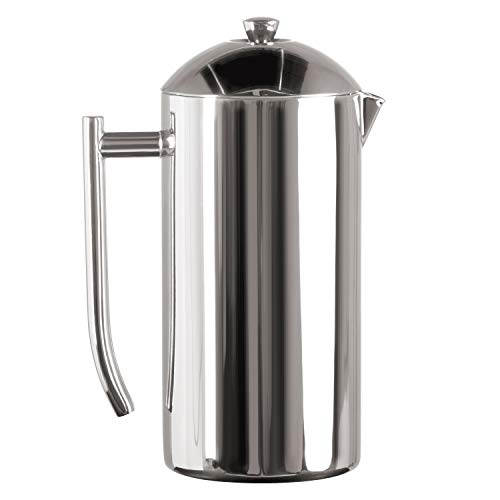
Long regarded as the gold standard for high-end presses. The 18/10 double-walled stainless steel keeps coffee hot far longer than glass or plastic, the two-stage filter keeps sediment down, and the polished finish is the kind of thing you are happy to set in front of guests. It is heavier and pricier than most — but it is built to last a lifetime and comes in several sizes.
Material: 18/10 stainless, insulated | Capacity: 36 oz (other sizes available) | Filter: Two-stage mesh | Best for: Keeping coffee hot and looking good
Check price on Amazon →4. Secura Stainless Steel (50 oz)
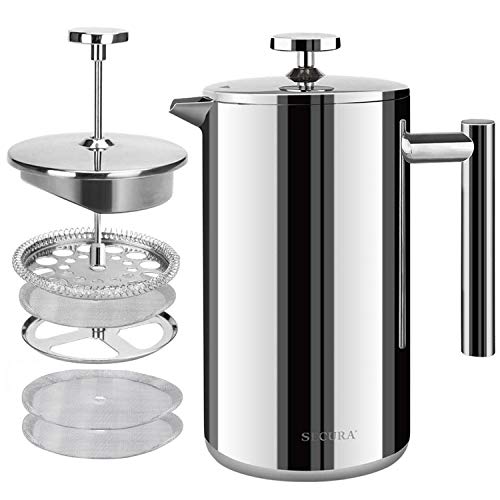
The smart-money pick. In head-to-head testing the Secura performs almost identically to presses costing three times as much: the 304 double-wall steel keeps coffee hot for over two hours while staying cool to the touch, and it ships with two extra filter screens so you can double them up for a cleaner cup or keep a spare. At 50 oz it is also the one to reach for when you are brewing for the whole table.
Material: 304 stainless, insulated | Capacity: 50 oz (1.5 L) | Filter: 3-layer mesh + 2 spare screens | Best for: Big batches and value
Check price on Amazon →5. Bodum Caffettiera

Proof you do not need to spend much to brew well. The Caffettiera pairs the same proven Bodum steel filter with a lightweight, BPA-free plastic carafe — which means it is practically unbreakable, perfect for a busy kitchen, an office, a dorm, or anywhere a glass press would not survive. It usually sells for under $25 and makes the same honest, full-bodied Bodum cup.
Material: BPA-free plastic + steel filter | Capacity: 34 oz | Filter: Reusable steel mesh | Best for: Budget buyers who want shatterproof
Check price on Amazon →6. Le Creuset Stoneware French Press

The one statement piece in this lineup. Stoneware is rare among French presses, and there is something genuinely lovely about it: Le Creuset's famed enamel coating gives excellent heat retention (better than glass, holding heat for over an hour in testing) and serious everyday durability, all in the brand's signature colors. If your press lives on the table rather than hidden in a cupboard, this is the one that earns its spot.
Material: Enameled stoneware | Capacity: 34 oz (1 L) | Filter: Stainless plunger | Best for: Design and the dinner table
Check price on Amazon →7. Espro P1 Travel Press

French press coffee anywhere. The P1 doubles as an insulated stainless bottle: add grounds and water, press, and the same Espro double micro-filter that makes the P7 so clean seals off the grounds so your coffee will not over-extract on your commute. No grit, no second vessel to carry — just brew and go. The ideal companion for travel, the office, or the trail.
Material: Double-wall stainless | Capacity: 12 oz | Filter: Double micro-filter | Best for: Brewing on the go
Check price on Amazon →Which French press should you choose?
If you just want the classic experience at a fair price, get the Bodum Chambord — it is the default for a reason. If a clean, sediment-free cup matters most to you, the Espro P7 is worth the splurge. Sip slowly or brew for a crowd? Go insulated steel: the Frieling if you want the premium piece, or the Secura if you want nearly the same performance for far less. On a tight budget or worried about breakage, the shatterproof Bodum Caffettiera punches above its price. Want something beautiful on the table, choose the Le Creuset. And if you are always on the move, the Espro P1 Travel Press brings the whole ritual with you.
How to brew the perfect French press coffee
The French press is the most forgiving brewer there is, but a few details lift it from good to great.
1. Use a coarse, even grind. Think coarse sea salt. This is the single biggest factor in avoiding a muddy cup.
2. Get your ratio right. Start at about 1:15 — roughly 30 g of coffee to 500 ml of water for a standard press. Adjust to taste. A simple coffee scale makes this repeatable.
3. Mind the water. Just off the boil, around 94°C, and filtered if you can.
4. Bloom, then steep four minutes. Pour a little water to wet the grounds, wait 30 seconds, then top up, stir gently, place the lid, and let it steep for four minutes.
5. Break the crust and press slowly. Stir the floating crust, then press the plunger down gently and evenly.
6. Decant right away. Pour all of it out, even what you are not drinking yet — leaving coffee on the grounds turns it bitter. For more, see our full guide to brewing Panama coffee.
The press is only as good as the beans inside it
A French press lays a coffee bare — so fill it with something worth tasting. Our award-winning Carmen Estate Geisha took 1st place for Washed Geisha at Best of Panama, scored 96.50 points, and sold for $10,005 per kilo at auction. Jasmine, citrus and floral in the cup, sourced directly from the producer in Panama and delivered worldwide in 5 days.
Shop Carmen Estate Geisha →Building out your coffee bar? Pair your press with the right grind and pour from these companion guides: the best coffee grinders, the best coffee scales, the best gooseneck kettles, the best drip coffee makers, the best home espresso machines, and the best AeroPress models and upgrades for a forgiving brewer you can travel with, and the best coffee storage canisters to keep your beans fresh. New to all this? Start with what specialty coffee actually is. And for another coarse-ground brewer, see our guide to coffee percolators. Love the body of a press but not the silt at the bottom of the cup? Try one of the best immersion coffee drippers, which steep like a French press and then filter through paper. Or see how it all fits together in the full equipment guide for Geisha.
French press FAQ
Is French press coffee better than drip?
It is different, not strictly better. A French press uses a metal mesh instead of paper, so the coffee's natural oils stay in the cup — giving a fuller, heavier, more textured brew that shows off a bean's body and origin character. Drip and pour-over use paper filters for a cleaner, lighter cup. Many specialty drinkers keep both.
How much coffee do I use in a French press?
Start at a ratio of about 1:15 by weight — roughly 30 grams of coffee to 500 ml of water for a standard press — then adjust stronger or weaker to taste. Weighing your dose with a scale gives you the same cup every time.
Why is my French press coffee gritty, and how do I fix it?
Grit almost always comes from grinding too fine or unevenly. Use a coarse, uniform grind from a burr grinder, and consider a press with a double micro-filter (like the Espro models) or add a paper filter on top for an even cleaner cup.
Stainless steel or glass French press — which is better?
Glass looks classic and lets you see the brew, but loses heat quickly. Double-walled stainless steel keeps coffee hot far longer and will not shatter, which is why it wins for slow sippers, big batches, and busy kitchens. Choose based on how fast you drink and how durable you need it to be.
How long should French press coffee steep?
Four minutes is the standard. Steep longer for a stronger cup, but always pour the coffee off the grounds as soon as you press — leaving it in contact with the grounds is what turns French press coffee bitter.
As an Amazon Associate, Boquete Coffee Traders earns from qualifying purchases.