

Best Cold Drip Coffee Makers (2026): 5 Kyoto Slow Drip Towers Compared
By Juan Carlos Sosa (@thecoffeejuan) | Boquete Coffee Traders
A cold drip coffee maker does something no pitcher of cold brew can. Instead of leaving grounds to steep for a night, it drips cold water through the bed one drop at a time, and that single change produces a completely different glass of coffee: clearer, more aromatic, lighter on the tongue, with the floral and citrus notes of a good washed coffee still intact rather than buried under a heavy, chocolatey body. If you have ever been served Kyoto-style coffee from a glass tower in a specialty cafe and wondered why it tasted nothing like the cold brew from your fridge, this is why.
The best cold drip coffee makers of 2026 run from a compact stack that lives on a shelf to a hundred-ounce tower built for cafes, and the differences are not cosmetic. Valve control, filter type and chamber size decide whether you get a clean, repeatable batch or a science experiment that channels and stalls. Here are the five I would put on my own counter, what each one is actually good at, and how to set a tower up so the first batch is a good one.
IN A HURRY? OUR TOP PICKS
- Best overall: Yama Glass 6-8 Cup Cold Drip Tower — hand-blown borosilicate, a ceramic filter and a valve you can actually dial in
- Best value tower: Nispira Iced Coffee Cold Brew Drip Tower, 6-8 Cup — the same three-chamber format and a proper adjustable valve for far less
- Best compact: Hario Water Dripper Clear WDC-6 — made in Japan, sits on a shelf, and drips as precisely as anything twice its size
- Best budget: Cold Bruer Slow Drip Coffee Maker — the whole method in a stackable glass-and-silicone unit you can leave on the counter
- Best large batch: Yama Glass 25-Cup Cold Drip Tower — a hundred ounces of concentrate in an afternoon, for a household that drinks iced coffee all week
Best cold drip coffee makers at a glance
| Cold drip maker | Type | Capacity | Drip control | Best for | Price |
|---|---|---|---|---|---|
| Yama 6-8 Cup Tower | Full tower, ceramic filter | 32 oz / 6-8 cups | Brass and stainless valve | The definitive Kyoto tower at home | $$$ |
| Nispira 6-8 Cup Tower | Full tower, paper and mesh filter | 6-8 cups | Adjustable stainless valve | Tower looks at a fraction of the price | $$ |
| Hario WDC-6 Water Dripper | Countertop, stainless mesh filter | 26 oz / 2-6 cups | Metal valve, drop by drop | Japanese build in a smaller footprint | $$ |
| Cold Bruer | Countertop, three stacked chambers | About 20 oz | Silicone valve, adjustable | Cold drip without the tower | $ |
| Yama 25-Cup Tower | Full tower, ceramic filter | 100 oz / 25 cups | Brass and stainless valve | Households, cafes, entertaining | $$$ |
Price guide: $ under ~$100 · $$ ~$100–250 · $$$ ~$250+
ON THIS PAGE
How cold drip is different from cold brew
Both use cold water, and that is where the similarity ends. Immersion cold brew — the pitchers in my guide to the best cold brew coffee makers — soaks coarse grounds for 12 to 18 hours. Every ground sits in the same water the whole time, so the extraction is deep, even and heavy: chocolate, caramel, a thick body, very little acidity, and, if I am honest, not much aroma. It is comforting rather than interesting.
Cold drip, the method behind Kyoto-style and Dutch coffee, works like a very slow pour-over. Water drips from an upper chamber through a bed of grounds one drop at a time and collects in a carafe below over three to eight hours. Each drop touches the coffee briefly and then leaves, taking the most soluble, aromatic compounds with it, so the concentrate comes out clear, sweet and fragrant with the origin character still there. A washed Geisha through a cold drip tower tastes like a Geisha. The same coffee steeped for a day in a pitcher mostly tastes like cold brew.
Two practical consequences follow. First, cold drip uses a finer grind than immersion, because the contact time per ground is short. Second, the drip rate is the recipe. A steady one drop per second is the classic setting; slower makes it sweeter and more concentrated, faster makes it thinner. So the quality of the valve matters more than anything else on the machine.
What makes a good cold drip coffee maker
A valve that holds its setting. This is the whole game. Cheap valves drift as the water level drops, so a batch that starts at one drop per second finishes at one every three, and the concentrate tastes inconsistent from the first glass to the last. Brass and stainless valves hold better than plastic; a silicone valve like the Bruer's works, but you will learn its dial by feel.
The filter. Ceramic filters, as on the Yama towers, give the cleanest cup with no paper taste and no sediment. Stainless mesh, as on the Hario, lets more oils through for a fuller texture at the cost of a little fine sediment. Paper is the cheapest and cleanest but is a consumable. Whichever you choose, a paper disc laid on top of the coffee bed stops the drip drilling a channel through the middle of the grounds.
Capacity, matched to how you drink. Cold drip concentrate is best inside a week. A 20 to 26 oz brewer suits one person. A 32 oz tower suits a couple. The 100 oz tower is for a household or for hosting; on your own you will be pouring stale coffee down the sink.
Height and stability. A full tower stands about 30 inches tall and the big one over three feet. That is a permanent spot, not something you get out on Sundays. If you do not have that space, a compact stack like the Hario or the Bruer makes the same coffee at a third of the height.
Glass you can replace. Towers are hand-blown glass and they do break. Yama and Hario both sell individual replacement chambers, filters and valves; with an unbranded tower, a cracked carafe usually means a new tower.
The 5 best cold drip coffee makers in 2026

1. Yama Glass 6-8 Cup Cold Drip Tower
This is the tower you have seen in specialty cafes, and it is the one I would buy if I only ever bought one. Every glass component is hand-blown borosilicate, the water chamber sits on a brass and stainless valve that holds a steady drip once set, and the coffee chamber drains through a ceramic filter rather than paper, so the concentrate comes out clean and clear without any paper taste. The spiral condenser coil is partly theatre, but it also slows and cools the drip before it hits the carafe, which is why the finished coffee tastes so soft. Standing about 30 inches tall it needs a permanent spot, and the glass is glass, so it is not for a kitchen with small children climbing the counters. A full batch takes around three to eight hours depending on how slow you set the valve, and the 32 oz carafe of concentrate keeps for a week in the fridge with the lid on.
Capacity: 32 oz / 6-8 cups | Filter: ceramic, reusable | Height: about 30 in | Best for: the full Kyoto experience, a coffee bar with room
Check price on Amazon →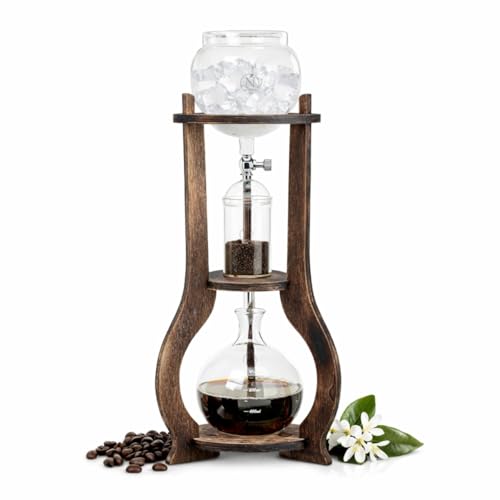
2. Nispira Iced Coffee Cold Brew Drip Tower, 6-8 Cup
If the Yama is out of reach, the Nispira gives you the same architecture without the premium: a wooden frame, thick glass chambers, an adjustable stainless steel valve to set the drip rate, and a filter that keeps the grounds out of the carafe. It brews the same 6-8 cups per cycle and produces a cup that is very hard to tell apart from the Yama in a blind tasting, because the method is doing the work, not the glass. What you give up is refinement. The glassware is thicker and less elegant, the valve takes a little more fiddling to hold a steady one-drop-per-second rate, and the instructions are brief, so budget an evening of watching it before you trust it unattended. For most people getting into cold drip, this is the tower I would actually recommend first.
Capacity: 6-8 cups | Filter: included, replaceable | Frame: wood | Best for: a first cold drip tower
Check price on Amazon →
3. Hario Water Dripper Clear WDC-6
Hario makes the V60 and the Buono kettle, and the Water Dripper carries the same discipline into cold drip. It is a tower in miniature: an acrylic frame instead of wood, glass upper and lower vessels, a metal valve that meters the water a drop at a time, and a stainless mesh filter that lets the coffee oils through for a rounder, fuller texture than paper gives. It makes up to 26 oz of concentrate, enough for two to six glasses, and because it is short enough to live on a shelf rather than a countertop it is the tower for a small kitchen. Two things to know. The mesh filter means slightly more fine sediment than the ceramic or paper towers, so let the carafe settle before you pour, and the acrylic frame is lighter than wood, so keep it somewhere it will not get knocked.
Capacity: 26 oz / 2-6 cups | Filter: stainless mesh | Made in: Japan | Best for: small kitchens, Hario loyalists
Check price on Amazon →
4. Cold Bruer Slow Drip Coffee Maker
The Bruer strips cold drip down to what matters: three stacked chambers, a silicone valve you turn to set the rate, and a glass carafe underneath. It is small, it is stable, and it is dishwasher friendly in a way none of the towers are. The cup is a little heavier than the Yama or Hario because the extraction runs warmer at room temperature in a smaller vessel, but it is still unmistakably cold drip: sweet, clear, low in acidity, with the aroma that immersion cold brew always seems to leave behind. At around 20 oz a batch it is a two-glass brewer, so it suits a single drinker rather than a household. The valve is the one part to be patient with; it takes a batch or two to learn where one drop per second lives on the dial.
Capacity: about 20 oz | Materials: borosilicate glass, stainless, silicone | Footprint: small | Best for: one person, tight counters, a first try
Check price on Amazon →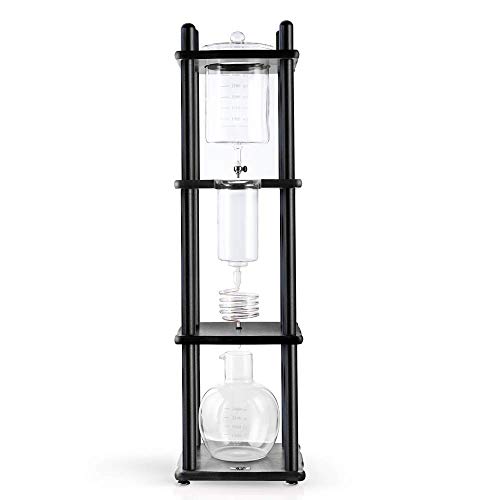
5. Yama Glass 25-Cup Cold Drip Tower
Same glass, same valve, same ceramic filter as the 6-8 cup Yama, scaled up to a 100 oz carafe. It is built for cafes, and that is where you usually see it, but it makes sense at home for a family of iced-coffee drinkers or for anyone who entertains, because a full cycle finishes in three to four hours and the concentrate holds for a week in the fridge. It is a serious object: well over three feet tall, heavy, and it needs a dedicated corner where it will not be in the way. If you drink two glasses a day on your own, buy the smaller one; you will be pouring out stale coffee. If four people drink it, or you make cold drip for guests every weekend, this is the tower that stops you brewing every second day.
Capacity: 100 oz / 25 cups | Filter: ceramic, reusable | Brew time: 3-4 hours | Best for: multi-drinker households, hosting, cafes
Check price on Amazon →Which cold drip maker should you choose?
Start with space and volume, not with the prettiest tower.
You want the real thing and you have the counter. Buy the Yama 6-8 Cup. The valve, the ceramic filter and the replaceable glass are why it is the cafe standard, and 32 oz is the right batch for one or two people.
You want a tower but not at that price. Buy the Nispira. It makes the same coffee with a little more fiddling, and if cold drip becomes a habit you can trade up later.
You have a small kitchen. Buy the Hario Water Dripper. It is a Japanese-made tower in miniature and it sits on a shelf.
You are curious and cautious. Buy the Cold Bruer. It costs the least, cleans the easiest, and it will tell you in two batches whether you are a cold drip person.
Four people drink iced coffee, or you host. Buy the Yama 25-Cup, and measure the corner it is going to live in first.
How to set up a cold drip tower for a clean batch
Most disappointing batches come from setup, not the tower. Six habits fix almost all of them.
Grind medium to medium-coarse. Finer than immersion cold brew, coarser than pour-over — roughly the coarse end of a V60 grind. The grind size chart has the target, and an even grind matters more here than in any other cold method because water passes through the bed only once. If your grinder throws a lot of fines, that is the upgrade to make first; the grinders I recommend for specialty coffee all hold this setting cleanly.
Level the bed and pre-wet it. Tap the chamber so the grounds sit flat, then drip or spoon a little cold water over the whole surface until it is evenly damp. Dry patches channel.
Put a paper filter on top of the grounds. A round paper filter laid on the bed spreads each drop across the surface instead of letting it drill a hole through the middle. The filters guide covers what fits; a cut-down flat-bottom filter works in a pinch.
Start at one drop per second and watch the first ten minutes. Set the valve, then check it again once the water level has dropped an inch, because most valves speed up or slow down as the head pressure changes. Adjust, then leave it.
Use a 1:10 ratio for concentrate. Roughly 50 g of coffee to 500 ml of water in a 6-8 cup tower gives a concentrate you can pour straight over ice or cut with an equal part of water. Go stronger for a syrupy Kyoto-style shot, weaker if you like it long.
Rest it. Cold drip tastes sharper straight from the tower. Lid on, fridge, and it is noticeably sweeter the next morning. Serve over clear or nugget ice that will not water it down.
And use a coffee worth the wait. Cold drip is the one cold method that shows off a delicate washed coffee instead of flattening it, which is why the towers in Panama's best cafes are usually running a Geisha. I have written up the estate coffees that work best cold, and my own step-by-step method for the immersion version is in how to make cold brew coffee at home.
The coffee a cold drip tower was built for
Our Panama Geisha — jasmine, citrus and floral in the cup, and every note of it survives a slow cold drip — is sourced directly from the producer in Panama and delivered worldwide in 5 days.
Shop Panama Geisha →Building out the cold side of your coffee bar? A tower sits between the two other cold methods worth owning: the immersion cold brew makers for heavier, easier batches and the flash brew iced coffee makers for a bright glass in four minutes instead of four hours. If you like the cup a Kyoto tower gives but want it hot, the immersion drippers and the siphon brewers deliver the same clarity and a similar glass-and-flame theatre. For serving that concentrate like a stout, the nitro cold brew makers put it on tap, and if you are still deciding where cold drip sits among everything else you could brew, the overview of coffee makers lays out the whole map.
Cold drip coffee maker FAQ
What is the difference between cold drip and cold brew?
Cold brew is immersion: coarse grounds steep in a pitcher of cold water for 12 to 18 hours and are strained. Cold drip, also called Kyoto-style or Dutch coffee, drips cold water through a bed of grounds one drop at a time over three to eight hours. Immersion gives a heavier, rounder, chocolatey cup. Cold drip gives a cleaner, more aromatic, tea-like cup with more of the origin character intact.
How long does a cold drip coffee maker take?
It depends on the drip rate you set. At the classic one drop per second, a 6-8 cup tower finishes in roughly three to five hours and a 25-cup tower in three to four. Slow the valve to one drop every two seconds and the same batch can run eight hours or more, which some people prefer for a sweeter, more concentrated result.
What grind size should I use for cold drip?
Medium to medium-coarse, noticeably finer than the very coarse grind used for immersion cold brew. Water only touches each ground briefly as it passes through, so it needs more surface area. If the water pools on top of the bed, go coarser; if it races through and the coffee tastes thin, go finer.
Do I need ice in the top chamber?
No. Ice and water together keep the drip cold and slightly slow the flow, which is how most cafes run their towers, but plain cold water works. If you use ice, top up the chamber with water as it melts so the drip rate stays consistent through the batch.
Are cold drip towers hard to clean?
They have more parts than a pitcher, but each part is simple. The glass chambers rinse clean, the ceramic and mesh filters rinse and dry, and paper filters are discarded. The one thing to watch is the valve: a few grounds or a dried coffee film inside it will change your drip rate, so rinse it through after every batch.
Is cold drip stronger than cold brew?
Not necessarily, but it usually tastes more intense. Cold drip produces a concentrate that many people drink neat over ice, while immersion cold brew is often diluted. Caffeine depends on your ratio and dose, not the method. Taste-wise, cold drip is brighter and more aromatic; cold brew is heavier and sweeter.
As an Amazon Associate, Boquete Coffee Traders earns from qualifying purchases.