

Best Milk Frothing Pitchers (2026): Latte-Art Steaming Jugs Compared
By Juan Carlos Sosa | Boquete Coffee Traders
If you have dialed in your espresso and your milk still pours flat, the pitcher in your hand is doing more of the work than you think. A good milk frothing pitcher is the difference between a thin, bubbly foam and the glossy, paint-like microfoam that lets you pour real latte art. Below are the six steaming jugs I would actually reach for, ranked and compared, from a barista-standard workhorse to spout-engineered pitchers built for pour control.
IN A HURRY? OUR TOP PICKS
- Best overall: Rattleware 12 oz — the barista standard; balanced weight and a spout that just works.
- Best premium: Fellow Eddy — a sharp fluted spout and precision fill lines for repeatable pours.
- Best for latte art: Subminimal FlowTip — a spout engineered specifically for clean, controlled pour lines.
- Best handleless: Normcore Handleless 15 oz — free-pour control for anyone learning to feel the milk.
- Best value: De'Longhi 12 oz — a dependable brand-name jug at a fair price.
- Best budget: Zulay 12 oz — measurement markings and a laser-welded handle for under fifteen dollars.
ON THIS PAGE
Best milk frothing pitchers at a glance
| Pitcher | Capacity | Spout style | Best for | Price |
|---|---|---|---|---|
| Rattleware 12 oz | 12 oz | Rounded, tapered | Best overall | $ |
| Fellow Eddy | 18 oz | Sharp fluted | Premium design | $$$ |
| Subminimal FlowTip | 15 oz | Engineered FlowTip | Latte art | $$$ |
| Normcore Handleless 15 oz | 15 oz | Round, handleless | Free-pour control | $$ |
| De'Longhi 12 oz | 12 oz | Rounded | Brand-name value | $ |
| Zulay 12 oz | 12 oz | Rounded | Budget | $ |
Price guide: $ under ~$25 · $$ ~$25–38 · $$$ ~$38 and up. Tap through for the current Amazon price.
What makes a good milk frothing pitcher
Three things separate a pitcher you fight with from one that disappears in your hand. The first is the spout: a tighter, more defined tip gives you a thin, precise stream for drawing latte art, while a broad rounded spout is more forgiving but harder to control at the finish. The second is balance and weight — a pitcher with a low center of gravity and a comfortable handle lets you make the small, steady wrist movements good pouring depends on. The third is size relative to your drink: you want the milk to fill the pitcher between one-third and one-half full after frothing, so a 12 oz pitcher suits single drinks and a 20 oz suits two. Stainless steel is the standard because it conducts cold quickly, so you can feel by hand when the milk hits temperature. Everything else — markings, coatings, color — is preference.
The six pitchers, reviewed

1. Rattleware 12 oz Latte Art Pitcher
This is the pitcher you see on café counters for a reason. The weight is balanced, the spout is tapered just enough to give you a controllable stream without being fussy, and the walls are thick enough to read milk temperature by touch. It is not the flashiest jug here, but it is the one I would hand a beginner and the one a pro would be happy to keep. If you buy once and never think about it again, buy this.
Capacity: 12 oz | Material: Stainless steel | Best for: One drink at a time, any skill level
Check price on Amazon →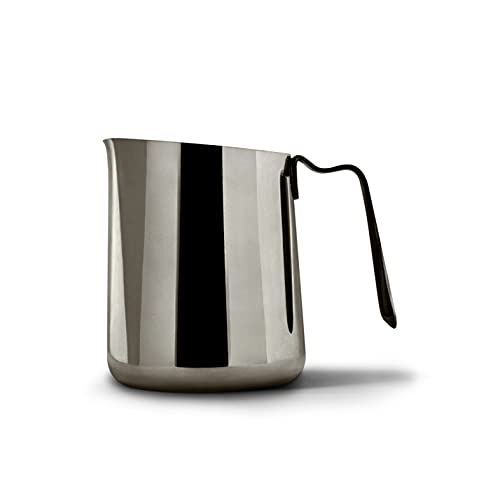
2. Fellow Eddy Steaming Pitcher
Fellow builds gear for people who care about the details, and the Eddy shows it. The spout has a sharp, precise crease that lays down a clean line, and the interior fill markings help you pour the same amount of milk every time — the quiet secret to consistent results. The graphite finish is handsome enough to leave out on the counter. You are paying for design and repeatability here, and if you steam milk every morning it earns its keep.
Capacity: 18 oz (also 12 oz) | Material: 18/8 stainless steel | Best for: Daily drinkers who want consistency
Check price on Amazon →
3. Subminimal FlowTip Milk Jug
The whole point of the FlowTip is the spout. Subminimal reshaped it specifically to give you two pour modes from one jug: a wide, forgiving flow for building the base, and a fine, precise stream when you tilt further for detail. If your goal is to actually draw hearts, rosettas and tulips rather than just get foam in the cup, this is the pitcher that shortens the learning curve. It pairs naturally with a handheld frother if you do not have a steam wand yet.
Capacity: 15 oz | Material: Stainless steel | Best for: Learning and refining latte art
Check price on Amazon →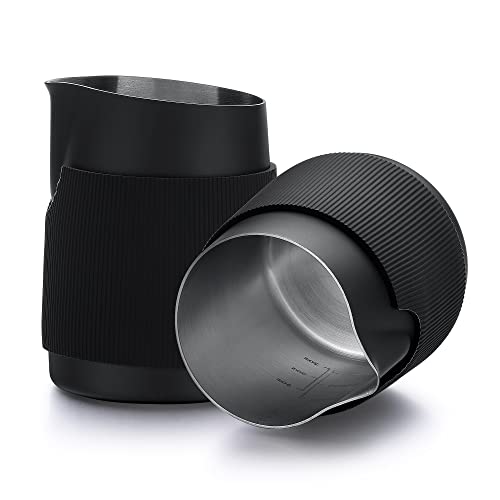
4. Normcore Handleless Pitcher, 15 oz
Handleless pitchers force you to hold the jug by the body, which sounds like a downside until you realize it puts your hand right on the milk. You feel the temperature climb and you feel the weight shift as you pour, and that feedback is a genuinely good teacher. The non-stick interior wipes clean, the round spout is friendly for free-pouring, and the price sits comfortably in the middle of the pack. A great second pitcher, or a first one if you like to learn by feel.
Capacity: 15 oz | Material: Coated stainless steel | Best for: Feeling temperature by hand
Check price on Amazon →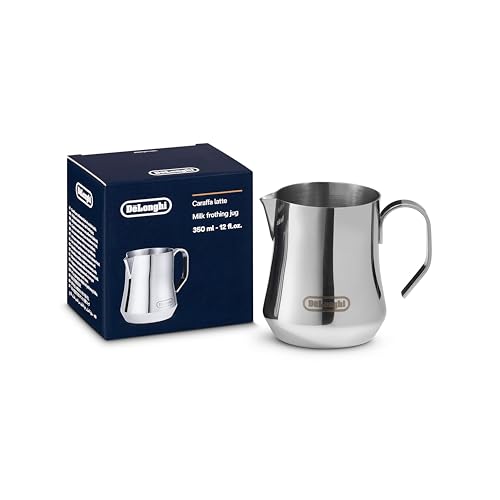
5. De'Longhi 12 oz Frothing Pitcher
A no-drama, brand-name jug that does the job without asking much of your wallet. The build is solid stainless steel, the spout pours cleanly enough for everyday cappuccinos, and if you already own a De'Longhi machine it is a natural match on the counter. It will not turn you into a latte-art champion, but it steams milk properly and lasts, which is most of what a pitcher needs to do.
Capacity: 12 oz (also 17 oz) | Material: Stainless steel | Best for: Reliable everyday steaming
Check price on Amazon →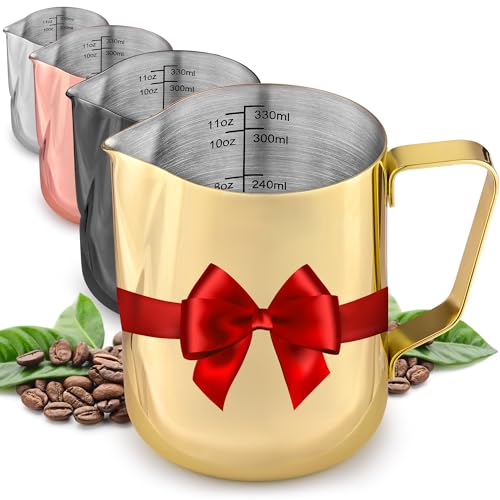
6. Zulay 12 oz Milk Frothing Pitcher
For not much more than the cost of two coffees out, the Zulay gives you a properly weighted stainless jug with interior measurement markings and a laser-welded handle that will not loosen. It is the pitcher I recommend to anyone who is not sure they will stick with home espresso and does not want to spend to find out. Start here, and if you fall in love with steaming milk you can graduate to one of the pours above.
Capacity: 12 oz (also 20 & 32 oz) | Material: Stainless steel | Best for: Trying home espresso on a budget
Check price on Amazon →Which milk frothing pitcher should you choose?
If you want one pitcher and no second-guessing, get the Rattleware 12 oz — it is the barista standard because it works. If you steam milk every day and care about pouring the same result each time, the Fellow Eddy is worth the premium for its spout and fill lines. Chasing latte art specifically? The Subminimal FlowTip is built for exactly that. Learning by feel, or want a smart second jug, points to the handleless Normcore. And if you are testing the waters, the De'Longhi or the budget Zulay will steam milk properly without a big outlay.
How to steam milk for latte art
The pitcher only matters if the milk is right. Start cold, and fill to just below the base of the spout — milk roughly doubles in volume, and you want room for it to expand. Introduce air only in the first few seconds, keeping the steam tip just under the surface so you hear a gentle hiss rather than a screech; that is where the fine microfoam is made. Then submerge the tip a little deeper and let the milk spin into a smooth whirlpool, which folds the foam into the milk instead of leaving it sitting on top. Stop when the pitcher is too hot to hold comfortably for more than a second or two, around 60 to 65 degrees Celsius. Tap the base once to knock out big bubbles, swirl until the surface looks like wet paint, and pour. Good microfoam and a well-shaped spout will carry you most of the way to your first heart.
Great milk deserves great coffee under it
Café Palo Alto — Boquete-grown Arabica with notes of chocolate, caramel and toasted nuts — is smooth, full-bodied and built to shine under steamed milk. Sourced directly from the Tedman family farm in Boquete and delivered worldwide in 5 days.
Shop Café Palo Alto →A pitcher is one piece of the setup. If you are still choosing how to froth, our guide to the best milk frothers for lattes and cappuccinos covers the machines and wands that pair with these jugs, and the best espresso accessories roundup rounds out your bar with tampers and distribution tools. Once the drink is poured, serve it in the right cup — see the best espresso cups and glassware. If you are still building the whole station, start with the best home espresso machines, and when you want to taste what all this gear is really for, our complete guide to brewing Panama coffee at home ties it together.
Frequently asked questions
What size milk frothing pitcher should I get?
Match the pitcher to your drink. A 12 oz pitcher is ideal for a single cappuccino or latte, while a 20 oz handles two drinks or a larger milk-heavy cup. You want the milk to sit between one-third and one-half full after frothing, so a pitcher that is too large leaves the milk too shallow to steam well.
What makes a pitcher good for latte art?
A defined, tapered spout that produces a thin, controllable stream, combined with a balanced weight and comfortable handle. Sharper spouts like those on the Fellow Eddy and Subminimal FlowTip give you more control over fine detail, while rounder spouts are more forgiving but harder to finish cleanly.
Can I use a milk frothing pitcher without an espresso machine?
Yes. A pitcher is just a vessel, so it works with a handheld electric frother, an automatic frother, or a steam wand. If you do not have a machine with a steam wand yet, pair a pitcher with a handheld frother to build microfoam, then pour from the pitcher as usual.
Do I need a thermometer with my pitcher?
Not necessarily. With a stainless steel pitcher you can feel the temperature through the metal and stop when it becomes too hot to hold for more than a second or two, roughly 60 to 65 degrees Celsius. A clip-on thermometer or a pitcher with a built-in temperature dot helps while you are learning.
Is stainless steel better than a coated pitcher?
Bare stainless steel is the standard because it conducts cold and heat quickly, letting you read milk temperature by touch, and it is easy to clean. Coated or non-stick interiors can make cleanup slightly easier and add color, but the coating can wear over time. For most people, plain stainless steel is the safe long-term choice.
As an Amazon Associate, Boquete Coffee Traders earns from qualifying purchases.